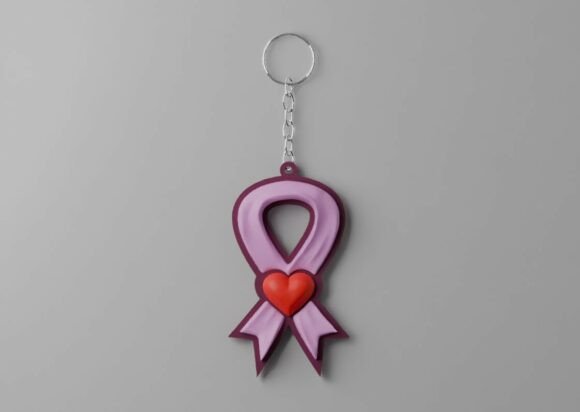
Transforming Solidarity into Physical Objects: The Awareness Ribbon Keychain STL 3D Model for 3D Print
In the rapidly evolving landscape of digital fabrication, the ability to translate abstract concepts into tangible objects has never been more accessible. One of the most poignant examples of this intersection between design, technology, and social advocacy is the Awareness Ribbon Keychain STL 3D Model for 3D Print. These small yet powerful artifacts serve as wearable symbols of support, remembrance, and community solidarity. For designers, hobbyists, and creators alike, accessing high-quality digital files allows for the mass production of meaningful items that can be distributed at events, sold to fundraise for causes, or gifted to loved ones.
The specific model discussed here represents a significant advancement in user-friendly 3D printing workflows. Designed with the "print-in-place" methodology, it eliminates the need for post-processing assembly, a common hurdle in traditional stereolithography or fused deposition modeling projects. This article explores the technical specifications, practical applications, and broader implications of utilizing such specialized STL files in both personal and professional contexts.
The Engineering Behind Print-In-Place Designs
At the core of this digital asset is a sophisticated approach to geometric design known as "print-in-place." Unlike traditional models that require separate components to be printed individually and then glued or snapped together, print-in-place designs utilize integrated hinges, joints, and moving parts that are formed during the single printing process. This requires precise engineering within the CAD (Computer-Aided Design) environment to ensure that tolerances are exact enough to allow movement without compromising structural integrity.
The Awareness Ribbon Keychain STL 3D Model for 3D Print exemplifies this complexity. The ribbon’s loop and knot structure are modeled with calculated gaps that allow the material to flex upon cooling, creating a functional clasp or decorative element without any manual intervention. This level of detail ensures that the final product looks clean and professional, avoiding the messy seams often associated with assembled prints. Furthermore, the geometry is optimized to prevent warping or detachment during the print cycle, a critical consideration when dealing with thin, delicate structures like ribbons.
This design philosophy not only saves time but also reduces the likelihood of human error during assembly. For educators teaching 3D printing principles, this model serves as an excellent case study in tolerance management and mechanical design. It demonstrates how digital tools can solve physical constraints, making complex mechanisms accessible to users with varying levels of technical expertise.
Material Considerations and Printer Compatibility
While the digital file provides the blueprint, the success of the print relies heavily on material selection and printer calibration. The creator of this model specifically tested the design using PLA (Polylactic Acid) on a Bambu Lab A1 Mini. This choice is strategic, as PLA is one of the most popular materials for beginners and professionals due to its ease of use, low warping tendency, and vibrant color availability.
- PLA Strengths: PLA offers excellent dimensional accuracy and surface finish, which is crucial for the fine details of a ribbon knot. Its rigidity ensures that the keychain maintains its shape over time, resisting deformation under normal wear.
- Printer Specifics: The Bambu Lab A1 Mini is known for its reliability and speed. Testing on this platform suggests that the model is compatible with modern, automated extruders that can handle rapid travel moves without sacrificing quality. However, the design is likely robust enough to perform well on other FDM (Fused Deposition Modeling) printers, provided they are properly calibrated.
It is important to note that while PLA is ideal for display pieces, it may not be suitable for heavy-duty industrial applications due to its lower heat resistance. For users intending to use these keychains in high-temperature environments, alternatives like PETG or ABS might be considered, though they may require adjustments in printing temperature and adhesion settings. The single-color nature of the design means that users can choose a filament color that matches the specific awareness campaign they wish to support, whether it be pink for breast cancer awareness, red for HIV/AIDS, or blue for prostate cancer.
Practical Applications and Use Cases
The versatility of the Awareness Ribbon Keychain STL 3D Model for 3D Print extends far beyond simple decoration. Its compact size and durable construction make it an effective tool for various practical scenarios, ranging from grassroots activism to corporate social responsibility initiatives.
Advocacy and Fundraising
Non-profit organizations and advocacy groups often struggle with budget constraints for merchandise. By utilizing a digital download, these entities can produce unlimited quantities of branded items without upfront inventory costs. Distributing these keychains at health fairs, charity runs, or community meetings helps raise visibility for specific causes. The act of giving a physical token of support can strengthen emotional connections between the organization and its supporters.
Educational Tools
In academic settings, these models can be used to teach students about the history of awareness campaigns alongside technical skills. An educator might assign a project where students design their own ribbon variations or analyze the structural integrity of different hinge mechanisms. This interdisciplinary approach bridges the gap between STEM education and social studies, fostering a deeper understanding of how technology can impact society.
Personal Commemoration
On a personal level, individuals often seek ways to honor loved ones who have been affected by illness or loss. A custom-printed keychain serves as a discreet yet meaningful reminder of resilience and hope. Because the design is error-free and clean, it carries a sense of dignity and respect, making it appropriate for memorial services or private keepsakes.
Benefits of Digital Downloads Over Physical Products
Opting for a digital STL file rather than purchasing a pre-made physical item offers several distinct advantages. First and foremost is the aspect of customization. While the base model is fixed, users can modify the file using slicing software or CAD programs to add text, change dimensions, or integrate logos. This flexibility allows for a highly personalized product that standard retail items cannot match.
Additionally, the environmental impact is significantly reduced. Traditional manufacturing involves shipping raw materials, finished goods across long distances, and packaging waste. In contrast, a digital download transfers data instantly, allowing the item to be produced locally on-demand. This just-in-time manufacturing approach minimizes carbon footprints and eliminates excess inventory that might otherwise end up in landfills.
Furthermore, the cost-efficiency is undeniable. Once the file is purchased, the marginal cost of producing additional units is limited to the price of filament and electricity. This makes it an economically viable option for small businesses or independent creators looking to generate revenue with minimal overhead.
Technical Workflow and Best Practices
To achieve the best results when printing the Awareness Ribbon Keychain STL 3D Model for 3D Print, adhering to specific workflow guidelines is essential. Although the design is intended to be user-friendly, attention to detail during the slicing phase can make the difference between a successful print and a failed attempt.
- Slicing Parameters: Ensure that your slicer software is set to print at a layer height that balances detail and strength. A standard 0.2mm layer height is usually sufficient, but finer layers can enhance the smoothness of the ribbon curves.
- Infill Density: Since the object is small and primarily aesthetic, a low infill percentage (10-15%) is adequate. However, increasing this slightly can improve the durability of the hinge mechanism if the keychain will undergo frequent stress.
- Support Structures: One of the primary benefits of this print-in-place design is the elimination of supports. Users should verify that no supports are generated in their slicer settings, as removing them could damage the delicate moving parts.
- Post-Processing: After printing, gently test the movement of the ribbon mechanism. If any minor friction is observed, a light sanding or the application of a small amount of wax can help lubricate the joint without affecting the overall appearance.
Conclusion
The Awareness Ribbon Keychain STL 3D Model for 3D Print stands as a testament to the power of accessible digital design. By combining thoughtful engineering with meaningful symbolism, it provides a versatile solution for those looking to make a tangible impact through 3D printing. Whether used for educational purposes, charitable fundraising, or personal expression, this model offers a seamless blend of functionality and sentiment. As the 3D printing community continues to grow, resources like this underscore the potential for technology to foster connection, awareness, and positive change in everyday life.